Once everyone figured out how to make distillate at scale, a kilo went from $50,000 to around $3,000. The knowledge that once separated operators became the baseline, and the margin that came with it vanished.
Margin compression in cannabis gets blamed on taxes, regulation, and pricing pressure, and those things are real. What does not get talked about nearly enough is how much of the margin problem lives inside the facility itself, in inefficient extraction workflows, in systems that were never designed for where the business is going, and in operational decisions that nobody wants to revisit or change because it works well enough to keep things going.
Running Blind on the Numbers That Matter
An operation incentivized purely by throughput, hit 500 pounds today, hit 1000 pounds tomorrow, will inevitably take hits to extraction efficiency and quality. Without tracking the potency delta between input biomass and output crude alongside solvent recovery rate, there is no way to know how much of the target compound made it through, how much stayed behind in the spent biomass, or how much time and energy each run is burning in recovery. The loss is happening whether it gets measured or not. You cannot recover what you are not measuring.
Yield is where this gets interesting. Let's say you start with 500 pounds of biomass, and 30 pounds of crude comes out. Most operators take the weight difference between those two numbers and call that their yield. Based on that math, a higher crude weight looks like a win. Crude weight is a quantity measurement. If that 30 pounds of crude is loaded with undesirables pulled alongside the target cannabinoids, the weight yield number looks great, while the actual extraction efficiency, how much of the available target compound in the input biomass made it into the output, is quietly destroying the margin.
An operator we worked with in Missouri is a good example of what happens when the right metrics finally get applied. They were hitting throughput targets, crude was coming out, and the operation looked functional from the outside. When we focused on the metrics that actually count, their extraction efficiency came in at around 70%, which by industry standards sits in the lower range of what a well-optimized hydrocarbon extraction operation should be achieving. By improving solvent recovery speed, upgrading chilling capacity, and integrating THCA crystallization into a system they largely already had, we took them from 70% to over 90% efficiency and quadrupled their throughput with the same labor, the same energy costs, and the same fixed overhead. When efficiency and throughput move together, the financial impact multiplies in ways that chasing volume alone never could have produced.
How Scaling Chaos Happens
Without the right metrics, an operation has no diagnostic tool for what is actually limiting it. When demand increases, the pressure to scale becomes real. If incomplete data informs the decision-making, operators usually add more equipment to the existing structure. Adding more of what worked at one scale doesn’t produce proportional results at a larger scale.
Active recovery systems using compressors are a good illustration of how this plays out. They were standard for years and performed well at a certain scale. As operations pushed more volume through them, the technology ran out of room. Every compressor has a ceiling defined by how much vapor the piston can grab per cycle, and every cycle generates heat that has to be managed with additional chilling. Adding a second compressor does not double the recovery capacity. It doubles the heat problem, doubles the complexity, and leaves the throughput ceiling largely where it was while energy and equipment costs climb. What shows up is lower revenue per run and a higher cost per unit.
Biomass columns are running into the same problem right now. Six-inch and eight-inch columns are a batch-oriented constraint, and operators trying to push more volume through them are adding more columns, extending column length, or engineering larger diameter caps. Each of those decisions adds labor, complexity, and cost without addressing what is actually limiting them. A continuous flow architecture, where biomass moves through extraction as an ongoing process rather than a series of discrete batches, solves the problem the column modifications are trying to work around. Adding columns makes the existing constraint more expensive to operate under.
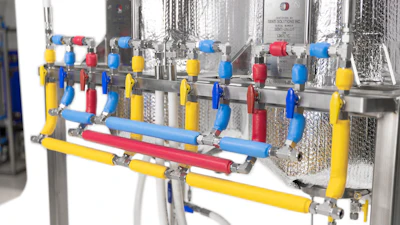
Decisions made in the heat of scaling: a hose added here, a quick connect routed there, each one solving an immediate problem without accounting for what comes next, turn a functional extraction lab into a jungle gym that operators spend their shifts navigating. Each of those movements seems trivial in isolation, but an extra thirty seconds here, a minute there, done five hundred times a day across a team adds up to thousands of lost labor hours annually, and at scale, that compounds into six and seven-figure losses that never get attributed to the layout decision that caused them.
In all three cases, the root cause goes untouched, the workarounds accumulate cost, and the margin damage builds across every run because nobody stopped to ask whether the approach being used was actually the right one for the problem at hand.
 Evolved Extraction Solutions
What Intelligent Operations Actually Look Like
The best-run extraction facilities share a few things that have nothing to do with having the newest equipment. They are clean, not spotless in a performative way, but clean in the way that tells you someone is paying attention to the details. Processes have a logic to them that operators can explain,, and someone actively questioning whether the current system is as efficient as it can be.
Knowledge does not live in one person's head, and processes are standardized across multiple operations such that a trained operator can run a shift and bring a new facility online. When the process lives in the system rather than in a single employee, the business can actually scale.
The margin problem does not have to break the business. Most operations already have more juice in the fruit than they realize, and the work is not about adding more equipment or chasing more volume. It is more so about squeezing harder on what is already available.
 Evolved Extraction Solutions