The cannabis industry has outgrown its first wave of automation. Early on, operators bought whatever machines promised speed, hoping that one good piece of equipment could solve a production problem. The results were predictable: patchwork lines that worked for a single SKU, packaging format, or product type, but couldn’t evolve. When a new trend hit, from infused pre-rolls to glass-tipped blunts or solventless products, those machines became expensive paperweights.
Rigid automation worked for stable, high-volume categories like beverages or household goods, but it doesn’t work for cannabis. The product mix changes quarterly. Packaging rules shift by state. Compliance requirements evolve faster than most ERP systems can update. A line that only runs one SKU isn’t an asset, it’s a liability waiting for the next trend.
Why Fixed Automation Failed
Traditional automation assumes predictability: identical inputs, repetitive motion, and uniform materials. Cannabis manufacturing has none of those. Flower density varies between cultivars, cones differ in thickness, and packaging tolerances shift between suppliers. When the product itself is dynamic, rigid machines lose efficiency fast.
Early adopters discovered this the hard way. A “cone filler” designed for standard paper cones can’t easily switch to blunts with glass tips. A packaging cell optimized for jars can’t pivot to bags or tubes without downtime and expensive retooling. Each adjustment often triggers a service visit, new components, or even a redesign. When you’re operating on tight margins and unpredictable demand, those pauses quickly cut into productivity.
The Integrator Gap
Other industries, like pharma or food, already rely on system integrators to make their lines run smoothly. These teams tie together the robotics, conveyors, sensors, and software so nothing works in isolation. If a pharma company switches to a new package type, the integrator updates the system to fit. Every piece of equipment speaks the same language through a shared control layer.
Cannabis has never had that luxury. Until recently, there were no industry-native integrators, no one designing production systems end-to-end with cannabis variability in mind. Operators mostly turned to OEMs that handled single steps in production. The equipment worked well on its own, but nothing really connected. People had to fill the gaps by keeping data straight, products moving, and compliance in check. In cannabis, the product changes faster than the plant floor. Robotics gives you the slack you need to keep up.
 Sorting Robotics
What Robotic Integration Looks Like
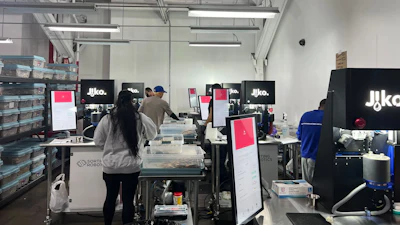
It’s time for the next phase of cannabis manufacturing to begin, with robotics-led custom integration.Think of it as orchestration rather than automation. A true integrator doesn’t just install machines, they connect them. They design a line where a robotic arm equipped with computer vision can pick up a tube, align it precisely, and feed it to a labeler that automatically syncs with compliance software. The system recognizes variances, adjusts on the fly, and logs every movement.
In a well-integrated cannabis facility, each process is modular and intelligent. If you swap from a 0.5-gram cone to a 2-gram blunt, you don’t have to rebuild the line. You change a recipe in the control software, and the system adapts. That flexibility transforms what was once a retooling headache into a ten-minute changeover.
Gentle Handling and Vision-Driven Precision
One of the biggest breakthroughs comes from replacing rigid automation with robotics that use positive feedback and vision systems. Traditional machines rely on fixed tolerances that assume the product never deviates. Robotics introduces adaptability. Cameras and sensors detect micro-variations in cones, joints, or packaging. Actuators adjust grip and pressure to prevent crushing or tearing delicate materials like glass tips or kief-coated products.
That level of precision isn’t over-engineering; it’s what allows operators to scale SKUs without sacrificing quality. As new infused formats emerge, robotics can evolve with them instead of forcing another capex cycle.
From Islands to Ecosystems
Integration brings separate automation systems under one roof. When every machine talks to the same network, the whole operation becomes easier to monitor and improve. Conveyors talk to fillers. Labelers feed compliance data upstream. Weight checks trigger automated rejection or alerts. Instead of juggling spreadsheets, operators can see what’s happening across the whole line in one dashboard.
It’s less about connecting machines for the sake of it, and more about keeping them running. With sensors tracking vibration and temperature, potential issues can be spotted before they cause a shutdown. Service agreements then ensure fast support and available parts turn maintenance from a fire drill into a predictable process.
When data from every machine comes together in one system, operators can finally see how each part of the line is performing. It’s the same kind of visibility other industries refer to as overall equipment effectiveness, or OEE. Instead of waiting weeks for reports, they can track output, downtime, and performance as it happens.
Real Results, Not Theoretical Promises
Examples from pre-roll production show how modular design and centralized control can make production lines more efficient. In production, some lines use flexible robotics that can handle several formats, like tubes, cones, and blunts, without swapping out machines. This reduces the time it takes to switch from one product to another and helps keep output consistent across different types.
Integration in this context emphasizes making the most of existing equipment. Coordinating machines and processes can boost efficiency and maintain flexibility, allowing operations to adjust as product formats or market demands change.
Designing for the Next SKU Cycle
No one can say what the top cannabis product will be in three years, maybe pre-rolls, maybe vapes, or something we haven’t seen yet. Building a facility for just one format is risky; it locks you into a setup that might not fit the market tomorrow. Integration based in robotics allows operators to design for change, building lines that evolve as regulations, packaging, and consumer preferences do. Think of integrators as building APIs between machines,the output isn’t data, it’s workflow.
A New Standard for Cannabis Manufacturing
The real opportunity isn’t just faster machines, it’s a smarter manufacturing framework. As cannabis grows into a mature CPG category, manufacturers will need the same adaptability and data discipline found in pharma, food, and advanced packaging. Robotic integration is how the industry gets there. In a business that moves fast and changes constantly, the answer isn’t more machines, it’s smarter systems. Operators need setups that adjust as the market does, built on solid data and flexibility instead of rigid automation.