For years, cannabis packaging rooms have relied on a patchwork of people, processes, and hand-built machines. Labels go on by hand, pre-rolls are stuffed one at a time, edibles are weighed and sealed in batches that vary from operator to operator. It’s a world away from the predictability seen in food or pharmaceuticals.
But that’s changing. As the cannabis sector matures, packaging and finishing operations are moving away from manual labor and ad-hoc fixes toward automation that’s modular, scalable, and most importantly, simple. We’re moving past the era of oversized, one-off packaging lines. The best setups are the ones operators don’t have to babysit. They integrate cleanly, start up fast, and hold steady through long runs. That’s the kind of reliability that actually moves production forward. A dependable automation setup reduces the unexpected stops and slowdowns that often appear as facilities take on higher volumes.
The key idea is this: simplicity doesn’t mean sacrificing sophistication. It means automation that’s accessible: Plug it in, connect the data, and start running.
Why Simplicity Matters More Than Ever
Margins across cannabis production are under pressure. Labor expenses keep rising, and compliance demands continue to expand. For manufacturers, that means errors like uneven fills, mislabeling, or downtime don’t just slow production, they threaten profitability in a market where every unit is tracked from seed to sale.
In that environment, the right automation doesn’t just cut costs; it reduces risk. Simplicity becomes a competitive advantage because it makes automation attainable for brands that can’t yet justify multi-million-dollar production lines.
We’re seeing more companies look for tabletop, plug-and-play “starter kits” for edibles and confectionery production. These compact systems handle dosing, depositing, and wrapping on a small scale but with industrial precision. A small operator can automate key steps, test recipes, and build consistency without heavy capital expense or complex setup. When the time comes to expand, that same foundation scales into a full production line.
In short: simplicity de-risks experimentation. It lets brands grow confidently, one step at a time.
From Handwork to Robotics and Vision Systems
Automation isn’t new to manufacturing, but in cannabis, it’s only now becoming mainstream. The real shift is happening in how robotics, AI, and vision systems are being applied.
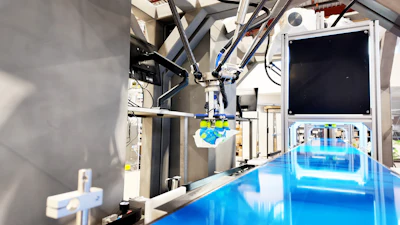
Today’s pick-and-place robots are gentle enough to handle gummies, pre-rolls, and glass jars without damage. Vision systems keep an eye on product counts, labels, and seals as each package moves down the line. The result is faster output and a digital record of every step, something no manual process can realistically provide.
In many packaging rooms, we’ve seen throughput triple after transitioning from hand-packing to semi-automated bagging and case-packing systems. Just as important, error rates drop and traceability improves, outcomes that matter just as much to regulators as they do to operators.
For cannabis brands, automation is no longer about chasing efficiency for its own sake. It’s about building reliability into every step of the process.
Integration Is the New Speed
The next frontier isn’t just faster machines; it’s smarter systems. In a mature packaging environment, integration matters as much as raw throughput.
Picture a packaging line where jars move from capping to labeling, wrapping, and case packing in one continuous motion. When equipment shares data in real time, product counts and quality metrics stay aligned from start to finish. Fewer manual steps mean fewer interruptions. If a section falls behind, the connected system can adjust on its own instead of stopping the whole line.
That’s the promise of all-in-one, turnkey systems and it’s where cannabis processing is headed. Integration reduces bottlenecks, minimizes compliance errors, and keeps product movement steady even when demand fluctuates.
For growing operators, modular automation systems that start small but connect easily are the bridge between manual production and enterprise-level efficiency. It’s not about buying one giant line; it’s about connecting simple, compatible building blocks that scale together.
Three Steps to Evaluate Automation
For operators exploring automation, the challenge often isn’t if they should automate, it’s where to begin. Based on what we’ve seen in cannabis packaging facilities across North America, three steps can help narrow the focus:
Map the bottlenecks, not the machines
- Examine the steps in production that consistently slow output or create extra waste. Addressing those areas first often brings the fastest return on automation investment. A well-chosen modular tool, whether a depositor or case packer, can often eliminate that problem without needing a full line overhaul.
Choose simplicity over specialization
- In traditional manufacturing, highly customized lines make sense. In cannabis, regulations, SKUs, and product forms evolve too quickly. Look for flexible, “plug-and-play” systems that can adapt to new products or packaging types without major retooling.
Integrate data early
- Every automation investment should contribute to better visibility: tracking output, weight, counts, and compliance data. Systems that generate real-time reports will save hours of manual logging and give you an audit-ready trail when regulators come calling.
- These steps aren’t theoretical. They’re what we see working on the floor every day.
The Human Side of Automation
There’s another misconception worth addressing: that automation replaces people. In practice, it does the opposite.
Automation changes the rhythm of work. The line runs smoother, and people have time to look after the details, the kind that make the difference between “good enough” and “ready for market.” It also steadies the schedule, which goes a long way toward keeping skilled staff on board.
That balance between people and automation is what drives sustainable scale. It’s how small operators become mid-sized, and mid-sized brands become multi-state players.
Looking Ahead: Building Smarter, Not Just Bigger
As we head into MJBizCon, one question keeps coming up: What does the next generation of cannabis manufacturing look like?
My answer is simple, literally. The future belongs to brands that adopt automation strategies grounded in simplicity, modularity, and integration.
The distance between an idea and a working line has never been shorter. Today’s automation systems aren’t prototypes or pilot projects, they’re running every day, proving that efficiency can be both simple and reliable. Small-footprint robots now handle pre-rolls accurately, vision systems confirm quality at each stage, and unified packaging lines move products through filling, labeling, and packing without disruption.
What matters now is accessibility and ensuring that these capabilities reach the operators who need them most, not just the industry giants. Simplicity doesn’t mean basic. It means automation that works from day one, scales as you grow, and keeps your team focused on what truly matters: consistency, compliance, and creativity.
The cannabis industry has reached the point where “good enough” manual processes no longer cut it. The operators who act now and invest in automation that’s easy to deploy, easy to scale, and easy to trust will define what efficient, compliant cannabis manufacturing looks like in 2026 and beyond.