For most of the industry’s history, the challenge was fairly straightforward: how do we put ground flower into a cone faster and more consistently than doing it by hand? That problem created an entire generation of preroll equipment, from knockboxes and vibratory fillers to increasingly sophisticated automated systems.
But the preroll category is changing faster than the equipment built to manufacture it.
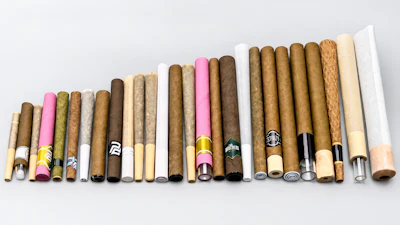
Walk into a production facility today and you may find everything from tiny 0.25-gram pinners to traditional 1-gram cones, straight prerolls, glass-tip products and multi-gram blunt tubes.
The category now stretches from ultra-small pinners to fat 3.5-gram straight tubes. Tomorrow’s bestselling preroll may look very different from today’s. The technology has to follow the product.
Infusion may be the biggest example. Producing an infused preroll consistently at scale introduces challenges that simply filling flower into a cone does not. Manufacturers have to think about how the concentrate is incorporated, how evenly it is distributed, how the material behaves in production and whether the finished product is consistent from the first preroll in a batch to the last.
Then consider what it takes to get something like an infused, glass-tip preroll all the way to a dispensary shelf. The material has to be prepared and infused, the preroll formed, filled to weight, closed, inspected and eventually packaged and labeled. Many of those steps still require separate equipment and manual handoffs.
 Infused prerolls introduce additional manufacturing challenges as producers combine flower and concentrates while maintaining consistency at scale.Hummingbird Preroll Systems
Much of today’s preroll technology is chasing the all-in-one machine—trying to automate as many steps as possible inside a single system. There is an obvious appeal to that approach, but it can also lock a manufacturer into a particular product and process. I think the next generation will look different: specialized equipment that solves individual processes well, but is designed to work together as part of a flexible manufacturing workflow.
The future, in my view, is a production floor made up of flexible, connected systems that can adapt to new products without forcing manufacturers to start over every time the market changes.
Speed will always matter, but units per hour can be a misleading way to evaluate automation. A machine capable of producing enormous quantities of one product isn’t necessarily the best investment for a manufacturer running multiple SKUs.
As the category diversifies, changeover time, labor requirements and the ability to handle different materials, sizes and formats become just as important as raw throughput.
The goal should be to touch the product less. Every time an operator has to pick up a preroll, weigh it, correct it, move it to another process or prepare it for packaging, we add labor and another opportunity for variation. The opportunity ahead is connecting more of those currently separate processes while maintaining the flexibility that cannabis manufacturing requires.
That doesn’t necessarily mean every producer needs a multimillion-dollar, fully automated production line. Some of the most important innovation will come from affordable, scalable equipment that allows manufacturers to automate incrementally. The long game is not simply buying a faster machine. It is building a manufacturing platform that can evolve as products, formats and consumer preferences change. A smaller operator should be able to automate the bottleneck they have today, then add capacity, processes and new product formats as their business grows.
We spent the first generation of preroll automation figuring out how to fill cones faster. The next generation has a much bigger job: handling infusion, new materials, new shapes and sizes, finishing, quality control and packaging as one practical manufacturing workflow—all while giving manufacturers the flexibility to make whatever consumers want next.
We have automated some of the steps. The long game of preroll manufacturing is just getting started.